"Voluntary Organization of Information Circulation for Education Employment and Entertainment"
skip to main |
skip to sidebar
12/21/2012

- The 2012 phenomenon comprises
a range of eschatological beliefs according to which cataclysmic or
transformative events will occur around 21st Dec, 2012. This
date is regarded as the end-date of a 5125-year-long cycle in the Mesoamerican Long Count calendar. Various astronomical alignments and
numerological formulae have been proposed as pertaining to this date, though
none has been accepted by mainstream scholarship.
- Apocalyptic fiction is a sub-genre of science
fiction that is concerned with the end of human civilization due to a potentially existential
catastrophe such as nuclear
warfare, pandemic,
extraterrestrial, impact
event, cybernetic
revolt, technological singularity, dysgenics, supernatural phenomena, divine judgment, runaway climate change, resource depletion, ecological collapse, or some other general disaster.
- Post-apocalyptic fiction is set in a world or civilization
after such a disaster. The time frame may be immediately after the catastrophe,
focusing on the travails or psychology of survivors, or considerably later,
often including the theme that the existence of pre-catastrophe civilization
has been forgotten (or mythologized). Post-apocalyptic stories often take place
in an agrarian, non-technological future world, or a world where
only scattered elements of technology remain. There is a considerable degree of
blurring between this form of science fiction and that which deals with dystopias.
- The genres gained in popularity
after World War
II, when the
possibility of global annihilation by nuclear
weapons entered the public consciousness. According to some
theorists, the atomic bombing of Hiroshima and Nagasaki in its modern past has influenced Japanese popular culture to include many apocalyptic
themes. Much of Japan's manga and anime is filled with apocalyptic imagery. Most notably, the 1954 film Gojira (romanized as Godzilla) depicted the title monster as an analogue for
nuclear weapons, something Japan experienced first-hand.
- Tom Hanks' 2011 web series Electric
City is another story based on a
post-apocalyptic world, in which a group of matriarchs (the "Knitting
Society") impose an altruistic but oppressive society to counter the
aftermath of a brutal war that brings down modern civilisation. However, in
time, even this new "utopian" order is ultimately called into
question by the inhabitants of the new society.
12/14/2012
- In epidemiology, a vector is any
agent (person, animal or microorganism) that carries and
transmits an infectious pathogen into another living organism.
- A vector-borne disease is one in which the pathogenic
microorganism is transmitted from an infected individual to another individual
by an arthropod or other agent, sometimes with other animals serving as
intermediary hosts. The transmission depends upon the attributes and
requirements of at least three different living organisms: [1.] the pathologic
agent, either a virus, protozoa, bacteria, or helminth worm); [2.] the vector, which
are commonly arthropods such as ticks or mosquitoes; [3.] the human host. In addition,
intermediary hosts such as domesticated and/or wild animals often serve as a
reservoir for the pathogen until susceptible human populations are exposed.
Nearly half of the world's population is infected by vector-borne diseases,
resulting in high morbidity and mortality, with the overwhelming impact in
developing countries located in tropical and subtropical areas and
relatively rare in temperate zones.
- Most commonly known
biological vectors are arthropods but many domestic animals too are important vectors or asymptomatic carriers of parasites and pathogens that attack humans or other animals. Arthropods form a major group of disease vectors with mosquitoes, flies,
sand flies, lice, fleas, ticks and mites transmitting a huge number of
diseases. Many such vectors are haematophagous, which feed on
blood at some or all stages of their lives. When the insects blood feed, the
parasite enters the blood stream of the host. This can happen in different ways.
- The concept of disease vectors has some commonality with certain other
concepts in medicine and veterinary science; it is worth comparing vectoring, zoonosis and carrier for perspective.
Zoonosis sometimes arises from purely adventitious or non-systematic transport of the infectious agent. For
example a housefly or a dog might accidentally, but routinely, carry the
pathogens of typhoid or cholera in external dirt without being in any special way adapted to
such a function. Technically such a process amounts to vectoring, and such
vectors are important in practice, though they are logically similar to airborne
disease and waterborne diseases.

12/14/2012
- On 14th December 1962, NASA’s Mariner II passed within 35,000km of
Venus, becoming the first spacecraft to successfully fly by another
planet.
- From this historic voyage, we learned that Venus rotates in a
counter direction to most planets in our solar system, has a
high-pressure carbon dioxide atmosphere and continuous cool cloud cover.
- Whither Mariner II now? Endlessly circling the Sun, in a heliocentric
orbit. Space debris: a serious problem for our immediate galaxy.
- Space debris, also known as orbital debris, space junk, and space waste, is the collection of objects in orbit around Earth that were created by humans but no longer serve any useful purpose. These objects consist of everything from spent rocket stages and defunct satellites to erosion, explosion and collision fragments. As the orbits of these objects often overlap the trajectories of newer objects, debris is a potential collision risk to operational spacecraft. The vast majority of the estimated tens of millions of pieces of space debris are small particles, less than 1 centimetre (0.39 in). These include dust from solid rocket motors, surface degradation products such as paint flakes, and coolant released by RORSAT nuclear powered satellites. Impacts of these particles cause erosive damage, similar to sandblasting. This damage can be partly mitigated through the use of the "meteor bumper", which is widely used on spacecraft such as the International Space Station. However, not all parts of a spacecraft may be protected in this manner, e.g. solar panels and optical devices (such as telescopes, or star trackers), and these components are subject to constant wear by debris (and to a much lesser extent, micrometeoroids).


12/13/2012


- On Dec 12th Kim Jong Un, leader of North Korea's tin-pot regime,
caught his own people and the rest of the world off-guard by successfully launching
an Unha-3 rocket into space and possibly putting a rudimentary
satellite into orbit. Experts said the same technology it takes to put a 100kg satellite into orbit could be the first step towards firing an intercontinental ballistic missile with an equivalent payload at America, provided that North Korea could also master re-entry and accuracy.
- The timing, just before the first anniversary of
the death of his rocket-loving father, Kim Jong Il, appeared to be aimed
primarily at solidifying the young Mr Kim’s leadership, as well as
bolstering his popularity among his oppressed subjects.
- Beforehand, news
of the proposed launch was censored in North Korea, possibly because of
the embarrassment that ensued in April, when a previous Unha-3 rocket flopped in front of the world’s media.
- The U.S. described the launch as “a provocative action”, while Japan’s
Foreign Minister said the government had officially
protested the launch to the DPRK and had called for the UNSC to take a
tough stand. Also, while Beijing had earlier expressed concern over the North’s actions, China
“believes the Security Council’s response should be cautious and
moderate, protect the overall peaceful and stable situation on the
Korean peninsula, and avoid an escalation of the situation”.
- North Korea’s launch of a rocket has put India’s plans to send an officials and businessmen delegation to Pyongyang (assessed whether talk of economic reforms in the reclusive nation was for real) in March next year in the deep freeze. New Delhi would prefer to stay away from North Korea for the time being
as the rocket launch violates U.N. Security Council Resolution 1874. There have been reports about North Korea undertaking agrarian reforms as well as wanting to attract investments. Some Indian officials witnessed the conditions in the North Korean
country-side when they recently accompanied a U.N. team for the food aid
programme. India contributed $1 million to the cause and was likely to
allocate a similar amount around the time when the delegation was to
visit North Korea.
- The Unha or Eunha is a North Korean expendable carrier rocket, which experts say utilises the same delivery system as the Taepodong-2 long-range ballistic missile. Its earlier attempt of launching Unha1,2,&3 was a big failure.
12/11/2012
Ultra high net worth individuals (UHNWIs) are individuals or families who have, by one definition, at least US$30 million in investable assets, or with a disposable income of more than US$20 million. The exact dividing lines depend on how a bank wishes to segment its market; for example, the term "very high net worth individuals" can refer to those with assets between $5 million and $50 million, with ultra high net worth individuals only those with above $50 million.
12/11/2012
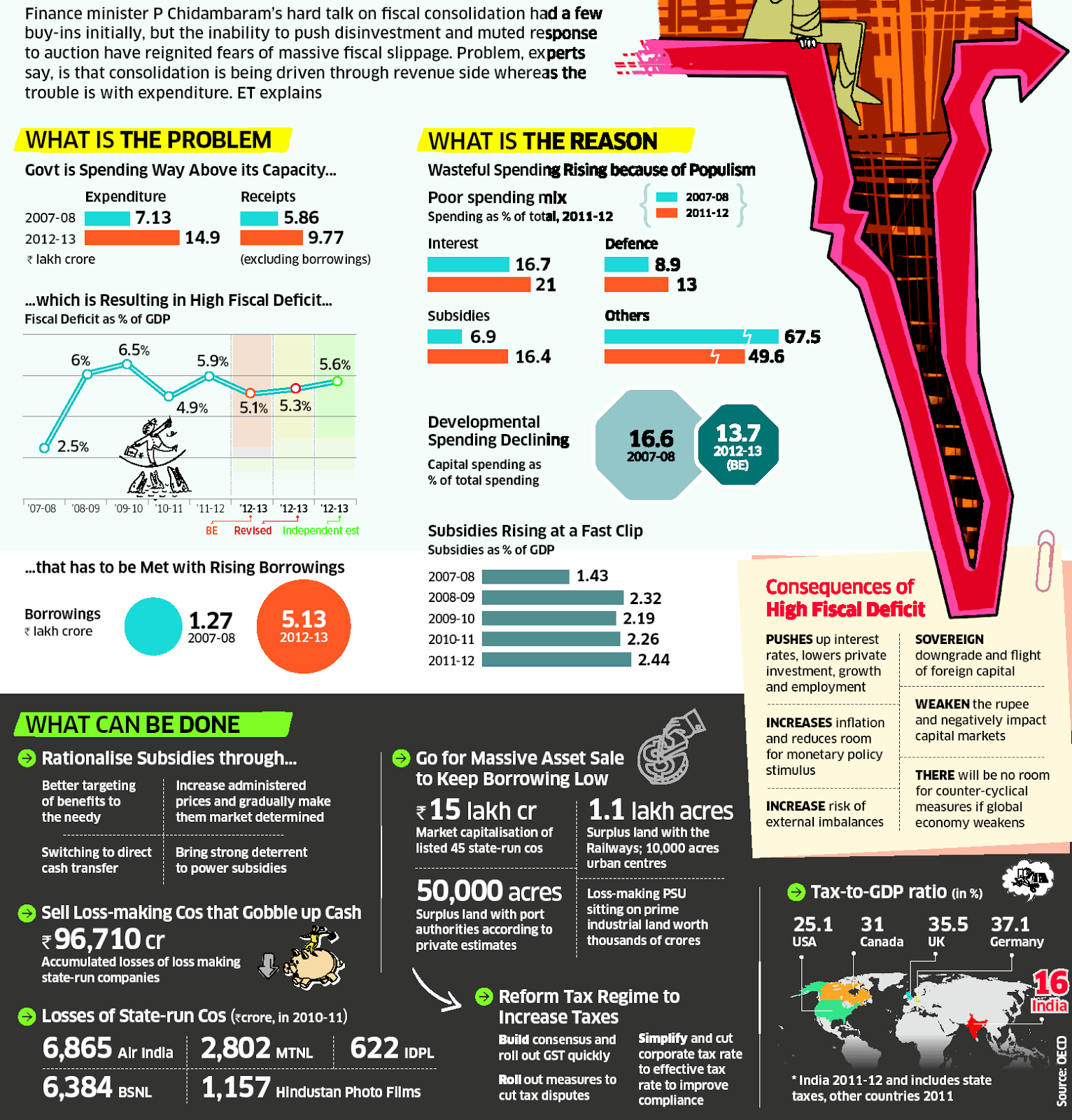
- The government has outlined the strong fundamentals of the economy and
said it was committed to rein in fiscal deficit within the target of
5.3% of gross domestic product.
- The government is battling hard to avert a ratings downgrade from the rating agencies like Moody or S&P and has
taken a series of measures to demonstrate its commitment to economic
reforms.
- Finance Minister had a meeting with the officials of Moody. The meeting comes a day after another ratings agency Fitch
cautioned that a loosening in fiscal policy ahead of the 2014
elections could further weaken India's public finances and put pressure
on ratings.
- It also warned that policy slippage or mounting evidence of a structural
decline in the trend growth rate, such as protracted weak economic
data, could cause the ratings to be downgraded.
12/07/2012
- North Korea is apparently readying her second rocket launch of 2012,
attempting to ping satellites in to orbit using ballistic missiles.
- Island neighbour Japan is a trifle nervous about it and is readying
Patriot missiles to islands close to the areas where the three rocket
stages are expected to crash land.
- There’s a fair amount of such military posturing and space activity
going on in that part of the world, which goes some way to explaining this, this and this.