"Voluntary Organization of Information Circulation for Education Employment and Entertainment"
Whatsapp
Showing posts with label Strategy: UPSC. Show all posts

{Strategy} UPSC-Toppers Voice: Venkat Raja (CSE 2011) shares his Preparation Experience

Written By VOICEEE on Sunday, December 23, 2012
Print Friendly and PDF


VENKAT RAJA
Rank: 878
Exam: Civil Services Examination
Year: 2011

{Strategy} UPSC-CDS: Combined Defense Service Exam (CDS) Cutoffs 2011

Written By VOICEEE on Monday, December 3, 2012
Print Friendly and PDF


There is no provision for reservation (categorywise) in CDS examination however, course-wise cut-off marks of written examination are as under

Name
IMA
AFA
INA
OTA
CDSE(I)-2011
90
111
45
72
CDSE(II)-2011
93
126
78
68

Source: 

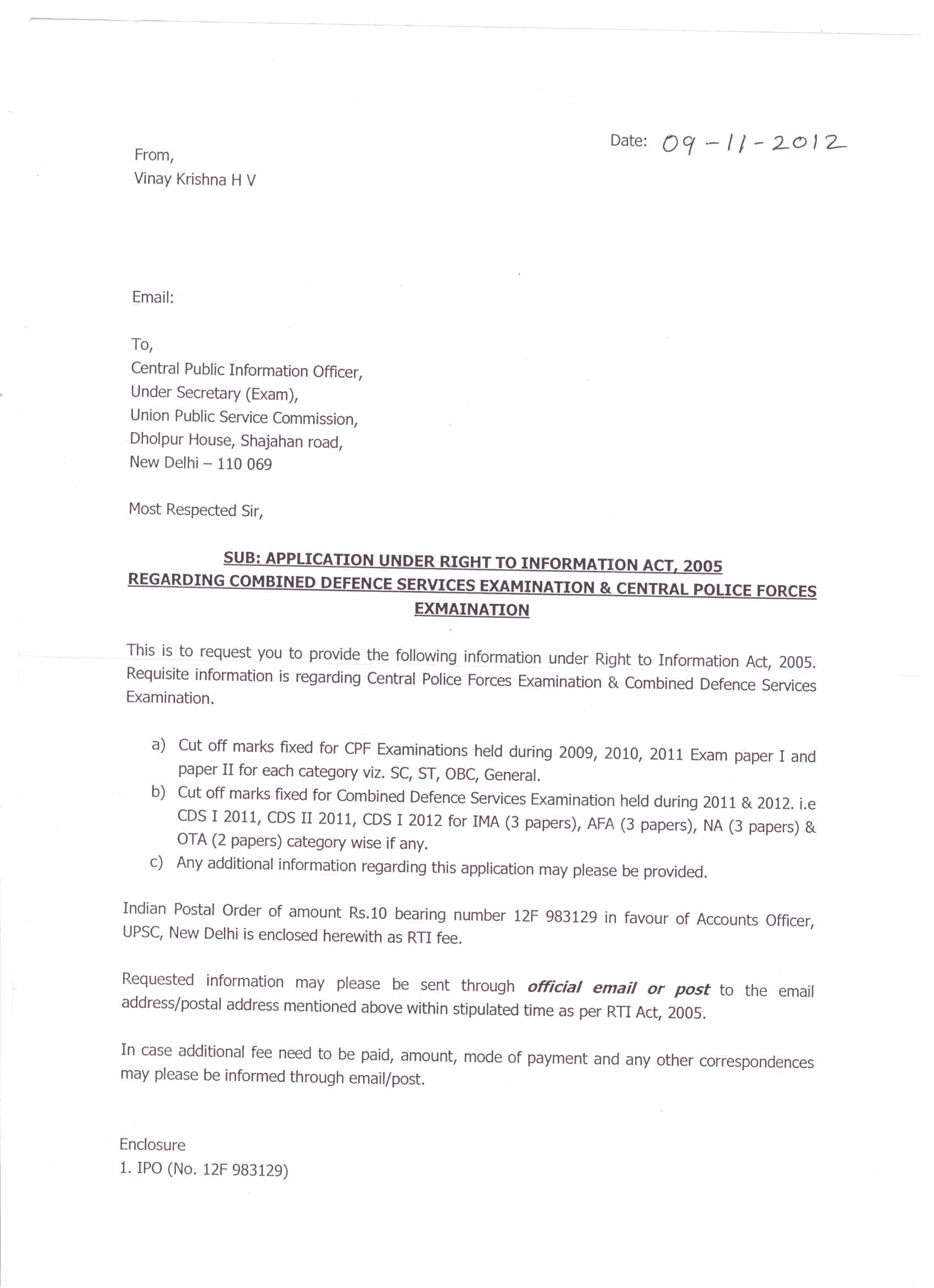
{Strategy} UPSC-CPF: Central Police Forces Exam (CPF) cutoffs in 2009, 2010


UPSC has refused to provide cut off marks of CPF 2011 citing the (cliched) excuse that recruitment process is not yet complete. 

However, cut-off marks for 2009 and 2010 have been provided as:

Year
Gen
OBC
SC
ST
2009
136
128
105
115
2010
126
121
111
116

{Strategy} UPSC-CSE: RTI reply - Optional subject removal, Nigavekar Committee

Written By tiwUPSC on Monday, November 26, 2012
Print Friendly and PDF


RTI Query: Please furnish information on the status of the Nigavekar Committee appointed by the UPSC, including the copy of the mandate setting up the committee, and the copies of mandates giving extensions to the said committee, if any. However, if the Committee has submitted its report, please give a copy of the report. Has UPSC given any deadline/ time limit to that committee to frame its report?

Reply: It is informed that Prof. Nigavekar Committee Report has been received by the Commission on 30.8.2012 and the recommendations of the Committee, after due consideration of the Commission have been forwarded to Govt. of India on 31.10.2012 and their response is awaited. It is further informed that the copy of the report/recommendations have not been made available to Public Information Officer by the Public Authority. Thus, Seaion 8(1)(d) of the RTI Act, 2005 is invoked, Public Authority being affected third Party. It is further informed that the copy of the report/recommendations have not been made available to Public Information Officer by the Public Authority. Thus, Seaion 8(1)(d) of the RTI Act, 2005 is invoked, Public Authority being affected third Party.

Comment: It Seems UPSC is going to do everything to protect the Top Secret information related to optional subject removal, disregarding the fact that many candidates are in limbo and coaching factories are making a killing due to this uncertainty.

{Strategy} UPSC-CSE: Marks scored by candidates in CSE (Preliminary) 2011


{Strategy} UPSC-CSE: The pattern of the Civil Services examination makes a mockery of the UPSC’s demand for ‘depth of understanding’ from candidates


  • The Union Public Service Commission’s Civil Services (Main) Examination, 2012, just got over. The results for this phase of the multi-tiered examination will be declared around March/April, 2013. Based on the marks scored in this examination, candidates will be shortlisted for the Personality Test, also known as interview, to be conducted around April/May, 2013. Based on their performance in the main examination and the interview, candidates will be recommended for All-India and Central government services.
  • The Constitution has tasked the UPSC with preserving the merit system in the country. The merit system, as opposed to the spoils system, may be defined as one in which recruitments are made on the basis of objective evaluation of skills and knowledge through open examinations. 
  • The ‘merits’ that UPSC looks for in the candidates are mentioned in its Notification for the examination, where it is emphasised that no marks will be allotted for superficial knowledge, and that credit will be given for orderly, effective and exact expressions. 
  • The main examination intends to assess, according to the UPSC, “the overall intellectual traits and depth of understanding of the candidates rather than merely the range of their information and memory.”
  • Even a brief analysis of the huge number of questions asked, length of answers stipulated and the three-hour time limit raises doubts about whether it is possible to find a candidate’s “overall intellectual traits and depth of understanding” through this type of examination. In fact, it seems the examination system and the stated desired outcome are quite incompatible.
  • For instance, the General Studies papers are common for all candidates. This year’s GS Paper I contained 33 questions requiring answers ranging from 250 to 10 words. In other words, candidates are expected to write a total of around 3,000 words within three hours to answer 33 questions.
  • How realistic is that? A normal student may struggle to put together 3,750 words, legibly written, on a pre-selected subject within three hours. It should be noted here that these 3,750 words are to be expended not on one question, but on 20 very different questions with no time given to think through them. It is unrealistic to expect candidates to show their true intellectual traits and depth of understanding in the answers they write in the short time given, on so many tricky questions. 
  • In GS I, a 250-word question asks for a “critical examination of the issues involved in the context of the growing demands for the ban of Endosulfan in the country. What, in your view, should be done in the matter?” Another question asking for a 150-word answer is: “There is an urgent need for the Planning Commission to revise the chapter on health in the 12th Plan document. Comment.” As should be evident, these are not very easy questions. Good answers to these questions require nuance and complex arguments, which in turn require thinking and time, even for someone well-versed with the subject. Framed with more time at hand, the answers to these questions may indeed help analyse a candidate’s intellectual traits and depth of understanding. But the problem is that the three-hour time limit does not allow for thinking, or even for basic organisation of thought. In the Civil Services (Main) examination, time is such that if you start thinking, you are in trouble.
  • How do candidates cope? Given the severely limited time given, one often has no choice but to cram and mug up so that you have as much information as you can on your fingertips. You practise writing continuously for speed and flow. You make notes and diagrams, or buy material from coaching centres. 
  • Weighted down by the clock, candidates usually write whatever comes to their mind. Some say that they gave opinions in their answers that on second thought, they would have reversed. That means the candidate’s answers often do not reflect his or her considered opinion.
  • Hence, while the questions may be good, the circumstances, especially the severely limited time relative to the number of words required, do not allow for proper answers to be given. The answers, written in a hurry, often give a misleading and deceptive account of the candidate’s ‘intellectual traits’. Add to this the requirement of mastering not one but two subjects, as part of two optional papers. 
  • All this load of work makes a mockery of the Commission’s pious demands for ‘depth of understanding’ from candidates. It all boils down to hard work, perseverance, tenacity, consistency, good memory, and good coaching notes.
  • As in previous years, around 1,000 candidates will eventually make the cut in this year’s examination cycle, counted from the highest mark until the vacancies are filled. They will be put through a gruelling training regimen and inducted into service. Some will shine. Others will be just mediocre, jack of all trade-types, good for gruelling routine, file-shuffling work. As for the deep-going, analysing, intellectual types that the UPSC professes to want, they would be lost in the rush. 


{Strategy} UPSC-CSE: Cut-off marks for UPSC CSE 2011

Written By tiwUPSC on Monday, November 12, 2012
Print Friendly and PDF


 Cat.Marks of last candidate selected in Prelims Exam 2011
Out of 400 marks
Marks of last candidate in Mains exam
Out of 2000 marks
Total marks of last candidate selected in Final merit list of
CSE-2011
Out of 2300 marks
General1988421090
OBC1758221059
SC1658071023
ST1617981009
PH-11357671008
PH-21247671047
PH-30966630911

 
© Copyright: VOICEee: Education Employment and Entertainment 2012 | Design by: VOICEEE | Guided by: Disclaimer and Privacy Policy | Powered by: Blogger.com.